Buyer’s Checklist for a 160 mm Through-Bore Slip Ring in Factory Automation
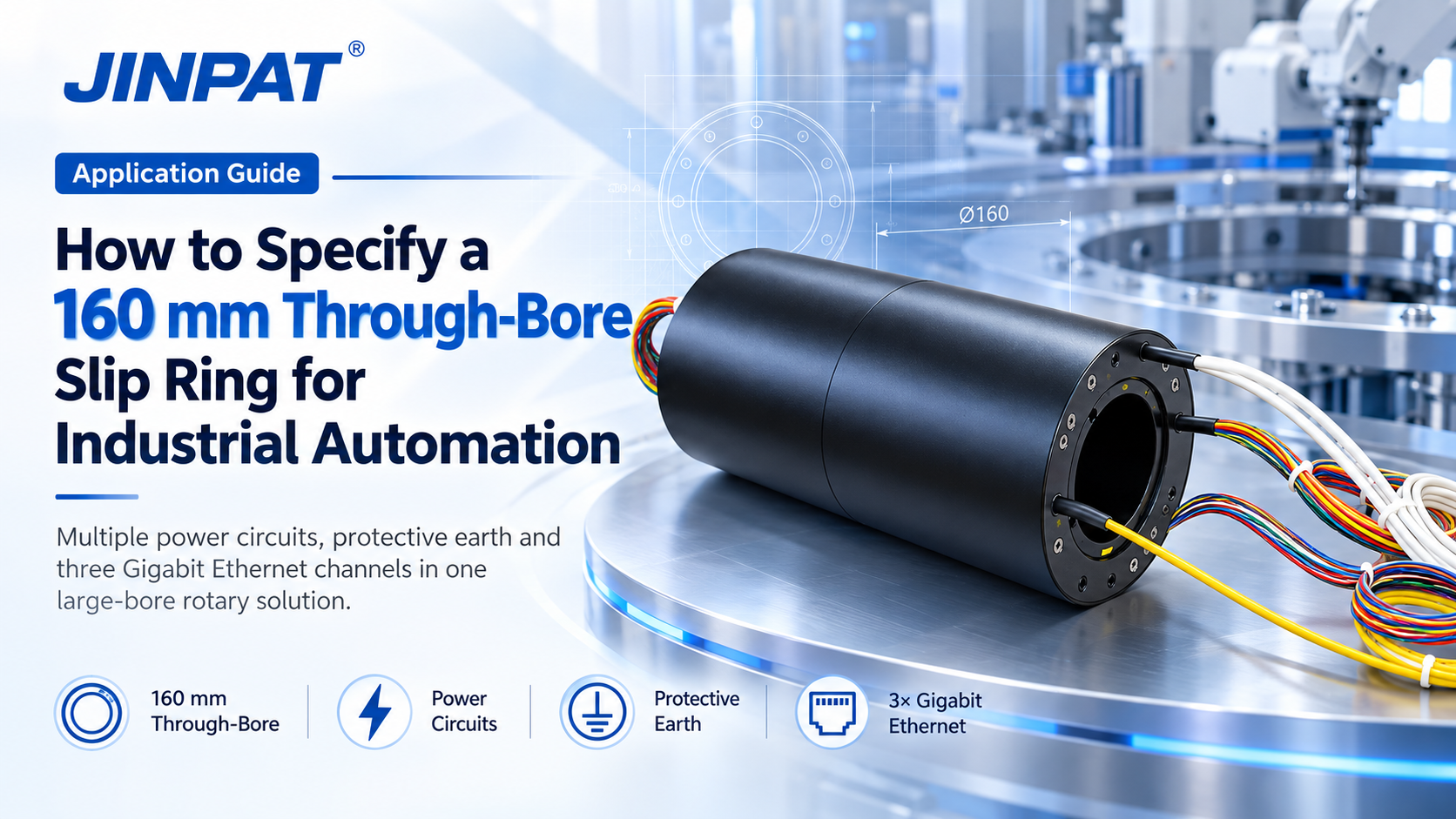
A quotation for a custom slip ring is only useful when every supplier receives the same technical information.
A product described simply as a “large slip ring with Ethernet” can produce very different proposals. The buyer should define the mechanical opening, electrical circuits, communication channels and environmental conditions before comparing suppliers.
The LPT160-0525-0816-01PE-3405-03E3 is a reference configuration with a 160 mm through-bore, several current levels and three Gigabit Ethernet channels.
Confirm the mechanical interface
Begin with the machine drawing.
The supplier needs to know:
Required clear bore
Maximum outside diameter
Available length
Mounting method
Rotating side
Fixed side
Cable exit direction
Shaft tolerance
Installation orientation
The nominal 160 mm bore should include enough clearance for assembly and normal movement of the component passing through it.
Issue a complete electrical schedule
The reference configuration includes five 25 A circuits, eight 16 A circuits, thirty-four 5 A circuits and one protective-earth circuit.
For every circuit, the RFQ should state:
Rated current
Working voltage
Peak current
Duty cycle
Load type
Required cable size
Terminal or connector preference
Buyers should avoid changing the circuit schedule after the mechanical design has been approved.
Define the Ethernet links
The product includes three Gigabit Ethernet channels, but the quotation request should define the complete link requirements.
Specify:
Cable category
Shielding
Connector type
Cable length
Connected equipment
Network topology
Required test method
If the machine uses different networks for cameras, control and diagnostics, identify each channel separately.
Describe the Vietnamese installation environment
Vietnamese factories can include air-conditioned production rooms, general industrial workshops and partially open installations. The RFQ should describe the actual environment.
Relevant information includes:
Operating temperature
Humidity
Condensation risk
Dust
Water exposure
Cleaning methods
Vibration
Corrosive substances
Do not request an IP rating without also describing how the complete assembly will be installed.
Compare documentation as well as hardware
A supplier proposal should include enough information for engineering review.
Request:
Outline drawing
Circuit table
Cable and connector schedule
Installation instructions
Test scope
Inspection requirements
Recommended spare parts
Revision number
Documentation quality can affect installation time and future maintenance.
Define acceptance before ordering
The purchase specification should state how the product will be accepted.
Possible checks include:
Dimensions
Bore clearance
Circuit identification
Continuity
Insulation
Protective-earth connection
Ethernet link verification
Rotation under defined conditions
The acceptance conditions should use the intended cables and connected equipment where practical.
Compare quotations on the same basis
Price comparisons are unreliable when suppliers quote different technical scopes.
Create a comparison table covering:
Compliance with each circuit requirement
Mechanical dimensions
Ethernet configuration
Included cables and connectors
Test documentation
Lead time
Warranty terms
Spare parts
Technical support
A controlled RFQ helps buyers distinguish technical differences from simple price differences.