High-Current Slip Ring Procurement Checklist for Coating Machinery
A Procurement Checklist for High-Current Slip Rings in Coating Machinery
Define the purchase scope before contacting suppliers
A request that says only 'high-current slip ring' will produce quotations that are difficult to compare. State whether the supplier is responsible for the slip ring alone, cables and connectors, mounting hardware, on-site support or system testing. Identify the rotating assembly and explain how the coating process uses it.
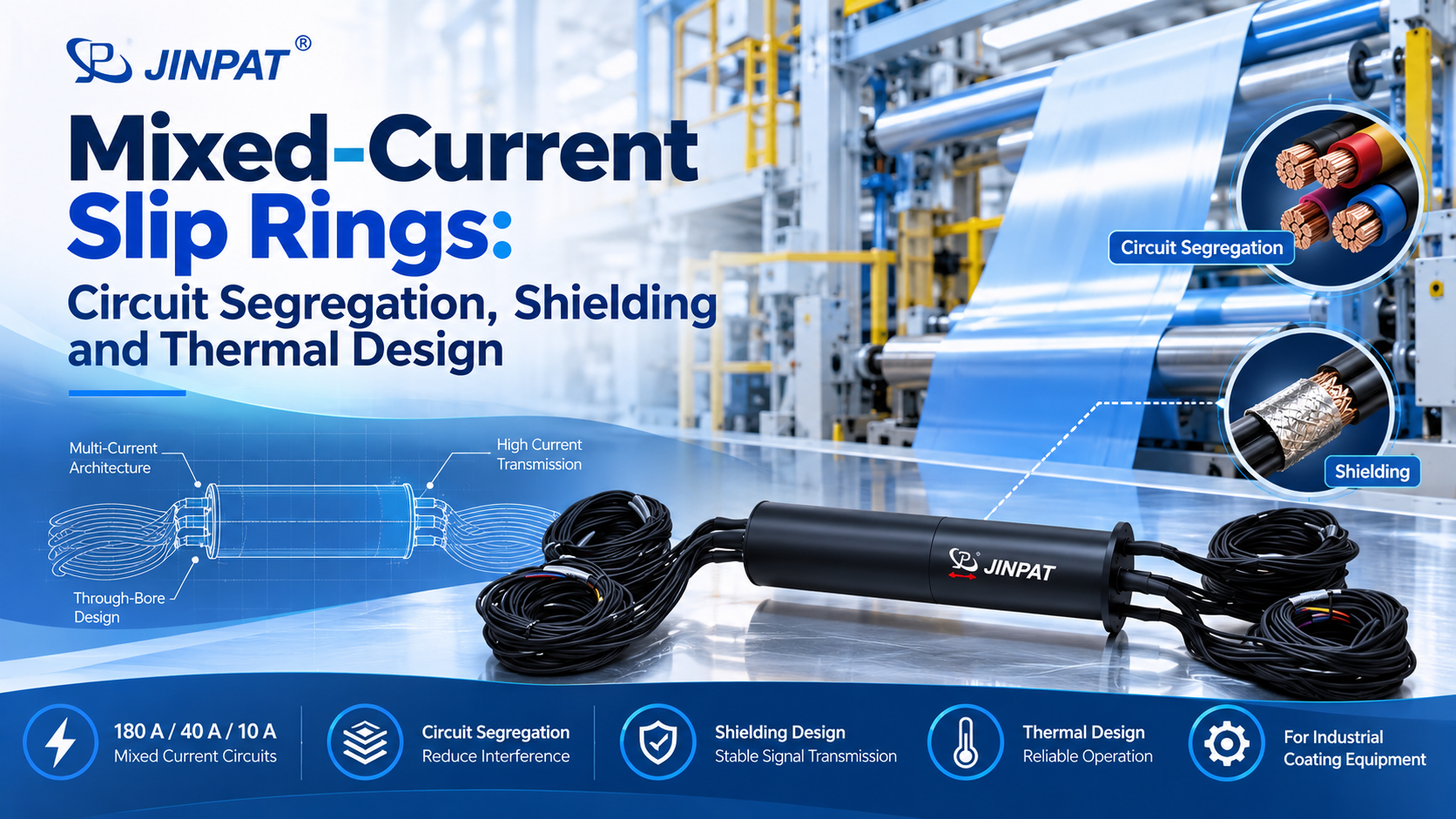
The reference configuration combines multiple high-current groups in a through-bore structure for coating equipment. It can help organize the RFQ, but the exact model and project code must be removed from public material.
Electrical checklist
Prepare a circuit table with one line per load. The recorded configuration contains eight 180 A circuits, sixteen 40 A circuits and ten 10 A circuits, with a listed maximum working voltage of 440 V. Ask each supplier to confirm which values are continuous ratings, what test conditions apply and how terminals are identified.
Include peak current, duration, repetition, load type, power factor where relevant and simultaneous loading. Ask how current groups are segregated and shielded. The source record notes individual shielding, but the quotation should also describe external shield termination and grounding responsibilities.
Mechanical checklist
Provide a controlled interface drawing. The reference dimensions are a 50 mm through bore, approximately 200 mm outside diameter and approximately 873 mm length. Ask the supplier to return a drawing showing mounting surfaces, tolerances, cable exits, terminal access, anti-rotation method and weight.
Confirm how the unit will be lifted, aligned and replaced. A through bore is valuable only when the shaft or process pipe can pass through it with the required clearance. Check surrounding guards and access panels during the layout review.
Factory environment and humidity
Vietnamese factories can have high ambient humidity, but conditions vary widely between air-conditioned production areas and open industrial spaces. State temperature, humidity, condensation risk, dust, process chemicals and cleaning method. Do not assume an IP rating or corrosion resistance unless the supplier confirms the complete configuration.
If the slip ring is installed near solvents or flammable atmospheres, a separate hazardous-area assessment is required. The source data does not establish explosion protection.
Documents to request
Request the approved dimensional drawing, circuit schedule, wiring diagram, terminal plan, material or compliance declarations required by the project, inspection instructions and test report format. Ask for English documents with revision control. Local installation teams should receive a clear cable and terminal identification scheme.
A strong supplier response distinguishes standard evidence from project-specific evidence. A general brochure cannot replace the released drawing and acceptance record for a custom high-current assembly.
Factory acceptance and commissioning
Agree on the factory acceptance test before the purchase order. Typical checks include dimensions, circuit continuity, insulation resistance, dielectric testing where applicable and rotation under defined load. If the line includes switching drives, plan a system test that can reveal unwanted coupling between groups.
At commissioning, verify alignment, cable strain relief, protective-earth connections and direction of rotation. Record baseline temperatures and electrical values. This creates practical evidence for warranty discussions and future maintenance.
Compare total project risk, not only price
A lower unit price may be offset by incomplete documentation, difficult terminal access, long replacement lead time or unclear testing. Compare technical deviations, delivery time, spare strategy, support responsibility and the cost of machine downtime.
Use one compliance table for all bidders. Mark each item as confirmed, deviated or pending, and require evidence for critical claims. This turns supplier selection into a controlled engineering decision.